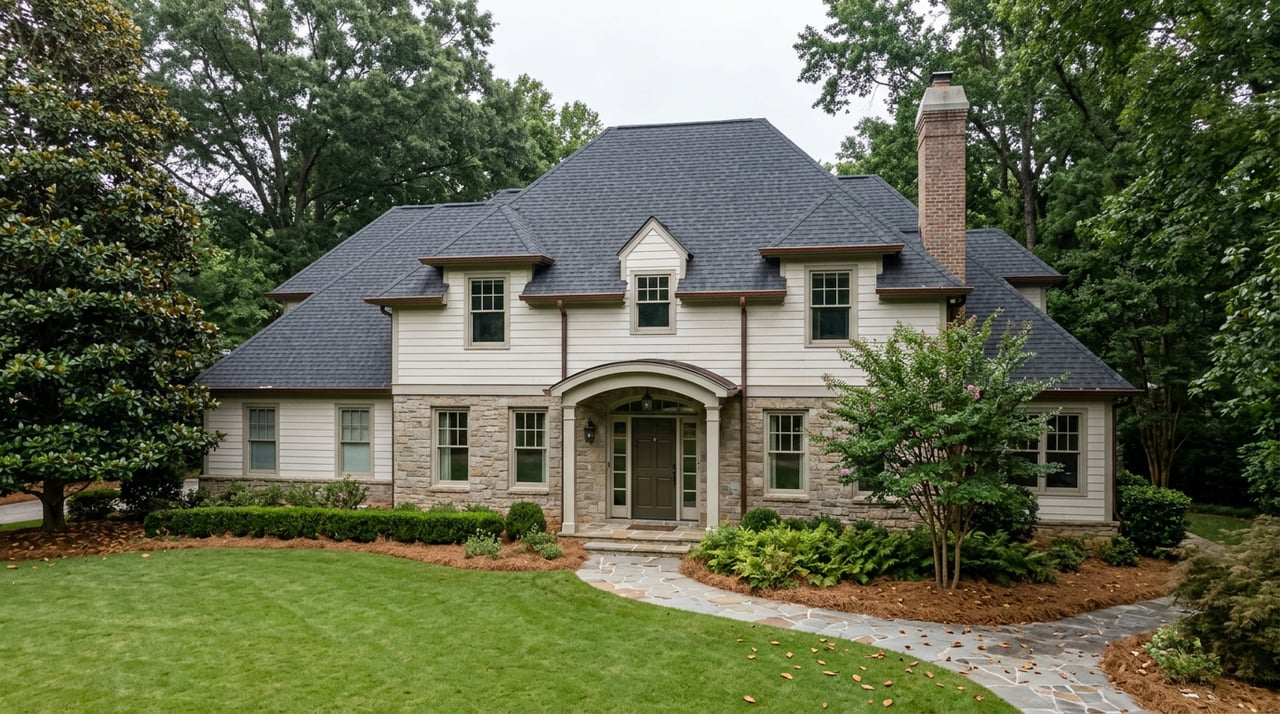
In Roswell's Historic District, Paint Is the One Renovation the City Can't Touch
September 10, 2026
September 10, 2026
"...except exterior paint alterations."
That clause sits inside Georgia's Historic Preservation Act, buried in the legal definition of what counts as a material change to a historic property. Most homeowners inside Roswell's Historic District never read it. They assume the opposite: that a citizen commission has to approve the color of their front door, their shutters, their whole exterior palette before a paintbrush touches the house. A 2014 opinion from the Georgia Attorney General's office, written specifically about Roswell's commission, confirmed that assumption is wrong. Exterior paint color is the one exterior change the city has no legal authority to review at all.
That single exemption tells you more about how the district actually works than any general description of "historic preservation rules" could. The commission's authority is narrower in one direction and stricter in another than most sellers expect, and the gap between those two facts is where renovation timelines and closing dates get into trouble.
Roswell's Historic Preservation Commission oversees design review across the city's 640-acre Historic District, the walkable core anchored by Canton Street. The City of Roswell requires property owners inside that boundary to obtain a Certificate of Appropriateness, commonly shortened to a COA, before making any of the following:
Windows, siding, rooflines, additions, fences, and site changes all fall inside that list. Under Roswell's code, a Land Disturbance Permit or a Building Permit cannot be issued on a property in the district until the COA is approved, which means the historic review isn't a parallel process running alongside your building permit. It's a gate the building permit has to pass through first.
Paint color sits outside that gate entirely. Georgia's Historic Preservation Act defines "material change in appearance" with a specific exception written into the statute, and the Attorney General's 2014 opinion walked through why: the state law, the Department of Natural Resources' model ordinance, and Roswell's own zoning ordinance all exclude exterior paint alterations from commission review. A local commission simply doesn't have the legal authority to regulate it, no matter what an internal design guideline might suggest.
For a seller prepping a historic-core listing, that's a genuinely useful piece of leverage. Repainting trim, shutters, a front door, or an entire exterior is the fastest, lowest-friction improvement available in the district. It requires no pre-application conference, no staff review, no meeting date to wait on. Everything else on that trigger list above does.
Not every COA moves at the same speed, and the split matters more than the paperwork suggests. Before submitting an application, every property owner has to schedule a pre-application conference with the city's Zoning Director. That single meeting decides whether the project gets routed as Minor or Major, and the two tracks operate on genuinely different clocks.
| Minor Certificate of Appropriateness | Major Certificate of Appropriateness | |
|---|---|---|
| Who decides | Zoning Director, at the staff level | The seven-member Historic Preservation Commission |
| Public hearing | Not required | Required; the Roswell DDA says the hearing must be advertised at least 7 days in advance |
| Timeline | Decision within 10 working days of a complete application | Tied to the commission's monthly meeting schedule |
| Classification decided | At the pre-application conference | At the pre-application conference |
That last row is the one people skip past. The classification isn't self-evident from the scope of work. A homeowner planning to swap a few windows might assume that's minor. Whether it actually is gets decided in a single meeting with staff, before an application is even filed. Anyone budgeting a renovation timeline around a Historic District property should schedule that conference early, not after a contractor is already booked.
Here's where the mechanics of a state statute turn into a real estate deadline problem. Georgia's Historic Preservation Act does build in a backstop for applicants: if a certified local commission fails to act on a complete application within 45 days, the certificate is considered approved by default. That's a real protection against a stalled process, but it also tells you the outer edge of how long a Major COA can legally sit unresolved.
Stack that against a typical contract. If a seller has agreed to complete exterior repair work as part of an inspection negotiation, or a buyer is counting on starting a renovation the week after closing, a Major COA that needs a public hearing has to clear the commission's monthly meeting calendar first. The commission's scheduled meeting was Wednesday, September 9, 2026, at Roswell City Hall, with sessions typically held once a month afterward. Miss a cutoff for that month's agenda and the review moves to the next one. A repair deadline written into a purchase agreement without accounting for that calendar is a deadline written against a process that doesn't move on the contract's schedule. It moves on the commission's.
A Major COA isn't a simple yes or no vote, and a 2020 case at Roswell Plaza, a shopping center near the corner of Norcross and Alpharetta streets inside the district, shows what that review actually looks like in practice. The developer proposed replacing the storefront's walls and windows with new brick veneer, wood siding, metal canopies, and window frames, along with new patios and landscaping. The commission approved the project, but only after attaching seven separate conditions covering materials, lighting, and screening.
Commissioners asked for a mockup of the brick and metal materials before final sign-off. They required screening to hide a utility locker on the property's west side. They asked the applicant to reduce the intensity of proposed LED lighting by roughly 12 percent. One commissioner pushed for continuity in the window and door dimensions across the building, while another suggested extending the brick facing further up the patio wall to match the rest of the structure. None of that came from a rulebook checklist. It came from a room full of people with a stated interest in architecture and local history, working through specifics one detail at a time.
That's the working style a homeowner walks into with any Major COA application, whether the project is a commercial storefront or a single-family addition. Coming to the pre-application conference and the eventual hearing with material samples, photos, and specifics ready tends to move faster than coming with a general description of the work.
For a seller, the practical order of operations is straightforward once the rules are clear. Repaint freely and treat it as sale-prep that carries zero regulatory lead time. For anything else on the exterior trigger list, especially work you're hoping to finish before listing photos or before a closing date, start with the pre-application conference at City Hall, not with a contractor's schedule. The Community Development Department's offices sit on the ground floor at 38 Hill Street, and the City of Roswell says every applicant is required to complete an orientation with staff before submitting the paperwork.
For a buyer, the useful habit is asking for the property's COA history before writing an offer that assumes quick cosmetic changes. A seller's prior approvals, or the lack of them, tell you whether the exterior work you're picturing has already been vetted by the commission or would need to start from a pre-application conference on your own timeline after closing.
Does a new roof need a COA? Roofing falls under exterior architectural appearance, which puts it inside the review requirement. Whether it's handled as Minor or Major gets decided at the pre-application conference based on the specific scope.
If I only want to change my house from white to a different color, do I need anything from the city? No. Exterior paint color changes are excluded from Certificate of Appropriateness review under state law, confirmed specifically for Roswell in the 2014 Attorney General opinion.
How long does a Major COA take from start to finish? There's no fixed number, since it depends on the commission's meeting calendar and how complete the initial application is. State law sets an outer limit of 45 days before a complete application is considered approved by default, but a hearing tied to a monthly meeting schedule can move faster or slower depending on when the pre-application conference happens relative to that month's agenda deadline.
If you're weighing a purchase inside Roswell's Historic District, or preparing to list a home there and want a realistic sense of what a renovation calendar actually looks like against a closing date, Lisa Gelber has spent years walking North Fulton buyers and sellers through exactly this kind of process detail. Let's Connect before you assume a timeline the commission's calendar can't actually support.
This article is general information, not legal, tax or financial advice. Consult a qualified professional about your situation.
Stay up to date on the latest real estate trends.
Lisa combines decades of local knowledge, professional organization, and responsive communication to create a smooth and successful real estate experience. Every client receives personalized attention and trusted guidance throughout the entire process.